
Restaurant data & decisions
Your restaurant data should not wait for the next management meeting
Bring sales, purchasing, staffing and accounting data together so your restaurant group can act before the next management meeting.
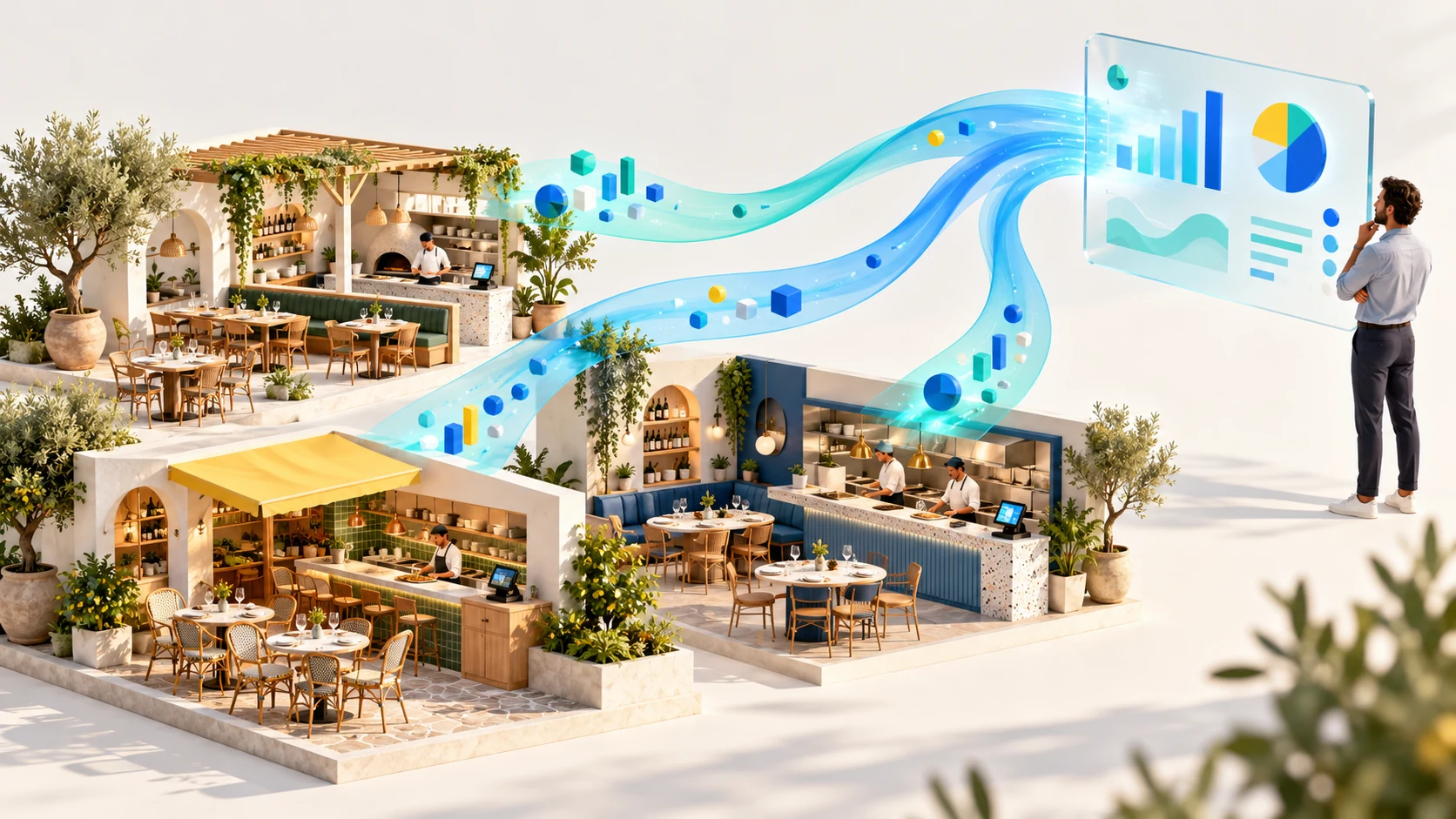
A sale is recorded at the till. A supplier invoice arrives. A team clocks out after a busy service.
Your restaurant systems capture these events every day. How long does it take for that information to reach the people making decisions?
For a restaurant group, the answer can depend on a chain of exports, spreadsheets, emails and reporting meetings. By the time the figures reach the leadership team, another week of purchasing, staffing and pricing decisions may already have passed.
Shortening that journey is one of the most practical improvements a growing restaurant group can make.
The distance between operations and decisions
In their essay From Hierarchy to Intelligence, published by Sequoia Capital in March 2026, Jack Dorsey and Roelof Botha describe hierarchy as a mechanism for routing information. Managers gather context, consolidate it and pass it through the organisation. They argue that AI can increasingly perform some of this coordination, supported by a continuously updated picture of the business.
For restaurant operators, this raises a useful question: how much of your reporting process exists simply to move information from one place to another?
Consider a regional manager collecting sales figures from ten restaurants. Each location sends a spreadsheet. Someone checks the totals, adjusts the formats and prepares a summary. The leadership team receives it at the weekly meeting.
Every step requires effort. Every handover can introduce delays or inconsistencies. Much of the underlying information was already available in the source systems.
Give everyone access to the same operational picture
A more direct approach starts by connecting sales, purchasing, staffing and accounting data to a shared foundation.
The information is collected automatically, checked and organised using consistent business definitions. Leaders can explore group performance and drill down into individual locations. Restaurant managers can access the figures relevant to their responsibilities.
Imagine a restaurant whose revenue is growing while labour costs are rising faster. Looking at sales alone, the week might appear successful. Bringing sales and actual hours worked together makes it possible to investigate which services account for the change.
The local manager can then explain the context: training new staff, covering an absence or preparing for an event.
The figures establish what changed. The conversation helps explain why and determine what to do next.
Direct access requires consistent definitions
Connecting systems is only part of the work.
Does “revenue” include VAT? Are refunds treated consistently? Does labour cost reflect scheduled hours or actual hours worked? Are restaurants using the same business-day cutoff?
Without common definitions, a group can produce a polished dashboard that compares incompatible figures.
A reliable data foundation needs consistent calculations, clear mappings between systems and visibility into missing or delayed records. Users should know when information was last refreshed and be able to trace a result back to its source.
This is what makes direct access useful: a number that people across the business can understand, verify and use with confidence.
AI makes that foundation even more valuable
With structured data in place, leaders can start asking questions in everyday language:
- Which restaurants lost sales compared with the same weekdays last month?
- Where did labour cost increase faster than revenue?
- Which products explain the change in average spend?
An AI assistant connected to governed data and defined calculations can make these questions easier to explore. Its answers still depend on the quality, completeness and freshness of the information underneath.
Building that foundation gives both dashboards and AI a consistent basis for analysis.
Bring decisions closer to the source
As a restaurant group grows, the path from an operational event to a management decision can become longer. More locations bring more systems, files and handovers.
A shared data infrastructure helps keep that path short. It gives leaders earlier visibility and gives operational teams more time to investigate issues and act on them.
At TucoData, we help restaurant groups bring their operational data together into a structured foundation for reporting, analytics and AI.
Your restaurants generate the information every day. Make it available while there is still time to act on it.
Want a clearer view across your restaurant group? Book a demo with TucoData.
Further reading: From Hierarchy to Intelligence — Jack Dorsey and Roelof Botha, Sequoia Capital, March 31, 2026.